
What is Brown Oak? The Remarkable Story Behind One of Britain's Most Beautiful Timbers
There is something rather wonderful about cutting into a piece of timber and discovering that the tree has left you a surprise.
Oak is one of our most familiar British timbers. We recognise its warm golden colour, its distinctive grain and the extraordinary strength that has made it a favourite of builders, shipwrights and furniture makers for centuries.
But occasionally, an oak tree produces something quite different.
Instead of the familiar honey-gold heartwood, the timber is streaked with rich chestnut, russet and chocolate brown. Sometimes the colour meanders through the wood in ribbons. Sometimes it spreads across almost the entire board.
This is brown oak.
And perhaps the most fascinating thing about it is that no one planted a brown oak tree.
There is no separate species called brown oak.
Its extraordinary colour is the result of something that happened during the life of the tree.
So, what exactly is brown oak?
Brown oak is usually English or European oak whose heartwood has been colonised by a fungus called Fistulina hepatica.
Its common name is considerably more memorable: the beefsteak fungus.
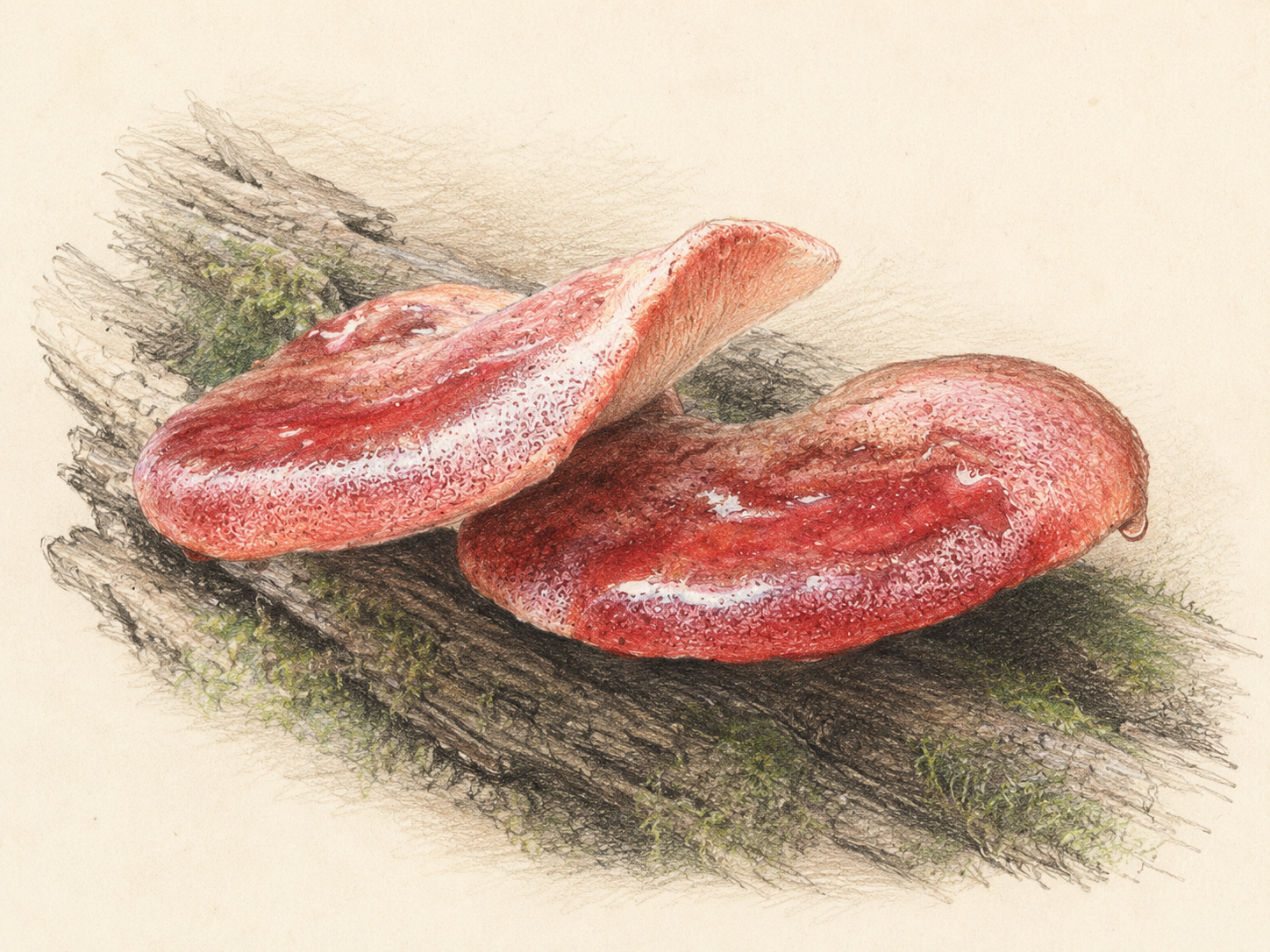
Beefsteak fungus
If you have ever spotted what appears to be a great red tongue emerging from the base of an old oak tree, you may have seen one.
The fungus gets its name from its rather remarkable appearance. Its fruiting body can resemble a piece of raw meat and, when cut, can even release a red, blood-like liquid.
But while the fungus itself appears on the outside of the tree, something fascinating is happening within.
As Fistulina hepatica interacts with the heartwood of the oak, it gradually changes the colour of the timber.
The pale golden oak begins to darken.
Sometimes the result is streaked or partially coloured timber often known as tiger oak. In other trees, much larger areas of the heartwood can develop the rich brown colouring that gives brown oak its name.
What was once an ordinary-looking oak has quietly become something very unusual indeed.
Nature has already done the designing
As furniture makers, we can choose the dimensions of a table. We can design the legs. We can decide how the edges should feel beneath your hand, how the joints should meet and how the proportions should work within a room.
But we cannot design brown oak.
That part happened long before the timber reached our workshop.
We cannot tell the fungus where to travel.
We cannot decide where the darker areas should begin and end.
We cannot reproduce a beautiful streak that appears across the grain.
And we cannot order another tree to create exactly the same pattern again.
That is one of the reasons we find brown oak so captivating.
Nature has already done part of the designing for us.
The role of the furniture maker is not to overwhelm that work, but to understand it.
To look at a board and decide where it should be cut.
Which surface deserves to be seen.
Which markings should become part of a tabletop rather than disappear beneath it.
And sometimes, importantly, when to leave something alone.
Is brown oak rotten wood?
This is an understandable question.
After all, brown oak has been affected by a wood-decaying fungus.
But the story is a little more interesting than simply describing brown oak as rotten timber.
Research into Fistulina hepatica has found that the fungus can cause the characteristic brown colouring during the earlier stages of colonisation without an appreciable loss of strength. If fungal decay progresses much further, however, the wood can eventually soften and become brittle.
This is why timber selection matters.
A furniture maker is not simply looking for the darkest piece of brown oak available. We are looking for beautiful, sound timber suitable for the piece we intend to make.
It is another example of why working with individual boards rather than treating timber as a completely uniform industrial material can make such a difference.
You have to look.
You have to understand what is in front of you.
And then you work with it.
Why is brown oak so sought after?
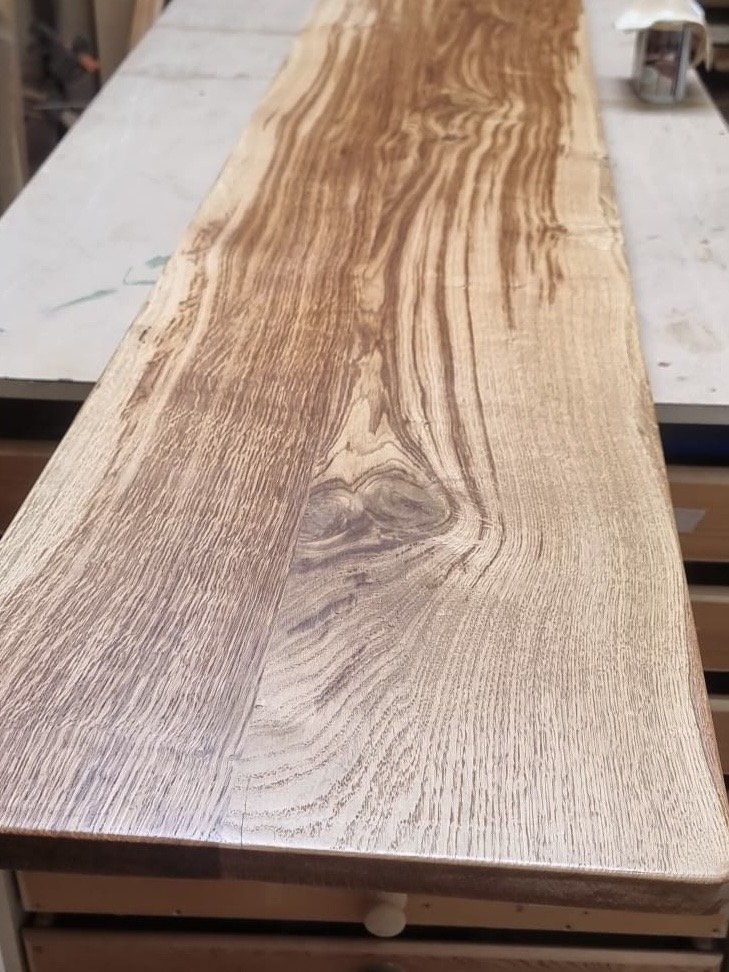
Brown oak board
Quite simply, because it is beautiful — and because it cannot be reliably manufactured to order.
Ordinary oak can be stained or treated to make it darker.
Brown oak is different.
Its colour has developed within the tree itself.
That creates a depth and variation which can be extraordinarily beautiful once a board has been prepared and finished.
One area might be warm caramel.
Another deep chestnut.
Another almost chocolate brown.
Against that colour sit all the familiar characteristics of oak: the grain, knots, medullary rays and the subtle changes that record the way that particular tree grew.
For furniture makers, that combination makes brown oak exciting material to work with.
And for the person who eventually owns the furniture, it means something else:
there will never be another piece quite like it.
Every brown oak tree tells a slightly different story
We have become very accustomed to uniformity.
We expect one product to look almost exactly like the next.
Nature has never been particularly interested in complying with that idea.
Trees grow on hillsides and in valleys. They experience wet summers and dry ones. They respond to prevailing winds, neighbouring trees, lost branches, injuries, insects, fungi and countless other events throughout lives that can span generations of our own.
All of those experiences help create the material hidden beneath the bark.
Brown oak makes that individuality particularly visible.
A sweep of darker colour isn't something we regard as a defect that needs to be disguised.
It is evidence of the life the tree has lived.
And we think that is worth celebrating.
From British tree to furniture
There is a strange moment in furniture making when a rough board begins to reveal what has been hidden inside it.
At first, timber can look rather unremarkable.
Its surface may be rough from the saw. It can be dusty, weathered and difficult to read.
Then the first clean surface appears.
The grain becomes clearer.
The colours deepen.
The character of the board begins to emerge.
With brown oak, that moment can be particularly special.
Once carefully worked and finished, those deep natural browns can become the defining feature of a dining table — something that catches your eye from across a room and then reveals more detail the closer you get.
That is why we don't believe beautiful timber needs to be made perfectly uniform before it can become beautiful furniture.
Quite the opposite.
Often, the most interesting furniture begins when we allow the individual tree to remain visible.
A table that couldn't simply be made again
There is another consequence of working with timber like brown oak.
When that particular board has gone, it has gone.
We could make the same table design again.
We could follow the same dimensions.
We could use the same joints and apply the same finish.
But the next tree would bring its own grain, colour, knots and history to the piece.
It would inevitably be different.
For us, this is part of the joy of making furniture from British-grown wood.
The material isn't merely something from which the furniture happens to be constructed.
It is part of the furniture's identity.
A dining table may remain in a home for decades. Children may grow up eating around it. Christmases, birthdays, hurried breakfasts, Sunday lunches and ordinary Tuesday-night suppers may all take place around its surface.
Long after the tree's life in the woodland has ended, something of that tree remains visible.
Its story hasn't disappeared.
It has simply entered another chapter.
Why we love working with brown oak
At Nuthatch Creations, we talk a lot about knowing where the wood in our furniture comes from.
Brown oak captures beautifully why that matters to us.
Because once you begin thinking about timber as having come from an individual tree, rather than simply seeing “oak” as a material on a specification sheet, you start noticing things differently.
The unusual colouring isn't an inconvenience.
The knot isn't necessarily something to cut out.
Variation doesn't automatically mean imperfection.
These are the characteristics that tell us we are looking at something that grew.
Something that stood in a landscape.
Something that had a life before it ever became furniture.
Brown oak makes that story particularly easy to see.
A fungus and an oak tree encountered one another.
Time passed.
The timber changed.
And many years later, a furniture maker opened a board and discovered the result.
We think there is something rather extraordinary about that.
From tree to table
Brown oak isn't beautiful because somebody succeeded in making every board look the same.
It is beautiful because they couldn't.
Every piece carries its own combination of colour, grain and markings, created through events that happened long before anybody knew what that tree might eventually become.
When we make furniture from timber like this, our aim isn't to erase that individuality.
It is to celebrate it.
To make something useful and beautiful that allows another part of the tree's story to continue — this time not in a woodland, but around the heart of a home.
Because a tree is never simply raw material.
It has already lived a story.
Our job is to make sure the next chapter is worthy of it.
See brown oak transformed into furniture
Discover our brown oak dining table and take a closer look at the extraordinary natural colour, grain and character of this remarkable British timber.